Over the course of two days, the workshop sessions explored both the complexity and promise of RNA-based treatments. International speakers addressed key challenges spanning the fundamental mechanisms of RNA biology, delivery barriers, manufacturing constraints, and the validation of advanced experimental models.
A recurring theme throughout the discussions was the need to overcome delivery limitations that currently restrict the effectiveness of RNA therapies beyond hepatic (liver) applications. Expanding RNA therapeutics into extrahepatic tissues remains a central priority for the field.
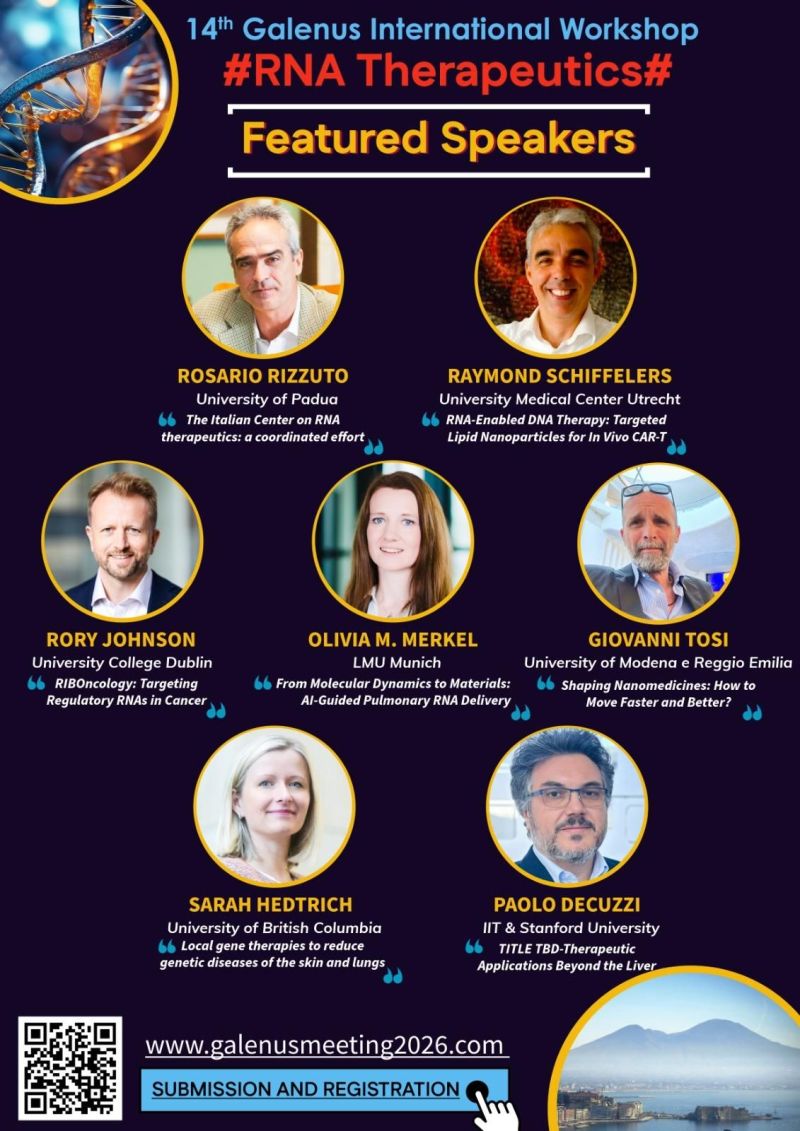
Among the notable contributions, Giovanni Tosi (Spoke 1) from the University of Modena and Reggio Emilia delivered an invited lecture on accelerating nanomedicine development. His presentation focused on strategies to streamline the translation of laboratory discoveries into clinical applications—an objective closely aligned with the National Center’s mission.
Building on this theme, Claudia Conte (Spoke 8) of the University of Naples presented her research on engineered polymeric nanoparticles designed for the selective delivery of siRNA to solid tumors. Her work demonstrated how precision delivery systems can improve therapeutic efficacy while minimizing off-target effects.
Similarly, Maria F. Brizzi (Spoke 8) from the University of Turin introduced an innovative approach using hybrid extracellular vesicle-based nanocarriers. Her study showed targeted siRNA delivery against IL-3 in triple-negative breast cancer, validated using zebrafish models.
One of the most significant takeaways from the workshop was the field’s ongoing shift toward extrahepatic applications. While early RNA therapies have largely focused on liver diseases, emerging delivery platforms and targeting strategies are opening new avenues for treating cancers, genetic disorders, and inflammatory conditions.
This expansion aligns closely with the strategic agenda of the National Center, which prioritizes scalable technologies capable of addressing unmet medical needs across a broad spectrum of diseases.
Since its founding in 2004, the Galenus Foundation has supported young scientists and fostered international collaboration through workshops and academic initiatives. The Naples conference continued this tradition, offering not only high-level scientific exchange but also valuable networking opportunities in an environment designed to encourage interdisciplinary collaboration.
As the event concluded, participants left with a renewed sense of momentum. With strengthened national coordination and growing international alignment, RNA therapeutics is increasingly positioned to transition from breakthrough science to widespread clinical impact in the years ahead.